Cutting Through the AI Noise: A RevOps guide to measuring what actually creates ROI

A RevOps leader's guide to measuring what actually creates ROI - and why both data and your team need a seat at the table before the next tool gets approved.

Everyone can be hitting their individual goals and working with the best intentions, yet the business can still go nowhere. Scalable growth requires a team aligned around a clear destination - and systems that turn individual effort into coordinated, repeatable progress.
If you lead RevOps, Sales Ops, or sit on the leadership team that funds these functions, you've felt it: a new AI tool lands in your inbox or LinkedIn feed almost daily, each one promising to fix pipeline, forecasting, or rep productivity.
It's exciting. It's also exhausting.
And for most teams, it isn't working the way the demos promised.
Clearly, that's not a knowledge problem. It's a measurement and process problem. This isn't an argument against AI tools - it's an argument for slowing down just enough to know, with real data, whether a tool is actually moving your numbers, and for talking to the people using it before you decide something is broken.
01 — THE LANDSCAPE
The tech stack is bigger than it's ever been, and that's part of the problem
There are now more than 11,000 GTM software solutions competing for budget, and the average organization uses only about 42% of the capabilities in the tools it already owns. Roughly 30% of SaaS spend goes toward underutilized software. Meanwhile, 47% of RevOps professionals rate their stack's overall ROI as average or worse, and 75% cite data inconsistency across systems as their single biggest frustration.
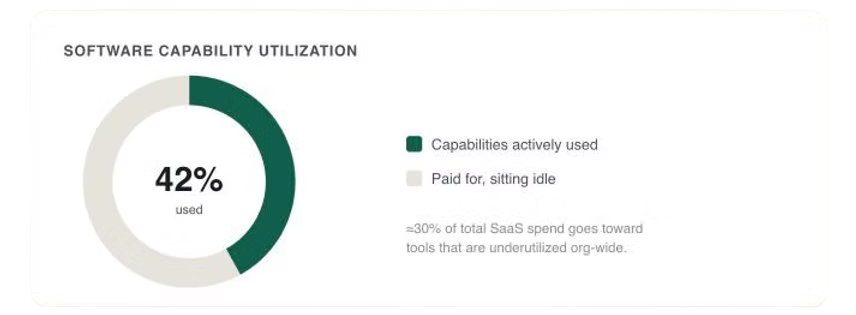
Put simply: most teams don't have a tooling gap. They have a data and governance gap that more tools tend to make worse, not better. When several systems are all writing to the same CRM fields on different refresh cycles and in different formats, you don't get a "unified view" - you get garbage data dressed up as one.
"You can't expect great AI output without the right combination of inputs." — The State of AI in Revenue Operations, H1 2026
This is why the instinct to buy the next AI tool to fix a broken process often backfires. If your underlying data isn't clean, consistent, and trusted, layering AI on top of it just means you're now making faster decisions on bad information.
02 — BEFORE YOU BUY
Get your data house in order
The single highest-leverage thing a RevOps leader can do before evaluating a new AI tool is make sure you can actually measure the thing you're trying to improve over time, not just at a single point in comparison to a vendor's benchmark.
Establish a baseline before you shop. If you can't state, in hard numbers, what your current sales cycle length, conversion rate, forecast accuracy, or rep time-on-task looks like today, you have no way to know if a new tool moved the needle three months from now.
Standardize your data definitions across systems first. A "qualified lead" or "closed-won" needs to mean the same thing in your CRM, your marketing automation platform, and your sales engagement tool.
Track trends, not snapshots. A tool that looks great in month one and quietly adds friction by month three will look identical in a single before/after comparison. Build lightweight, recurring reporting — monthly is usually enough.
Calculate ROI as a real formula, not a feeling. Include the hidden costs: implementation time, training, and the ongoing cost of someone maintaining the data feeding it.

For context on what good looks like: companies with mature, well-instrumented RevOps functions have been shown to outperform the market on stock price by as much as 71%, and well-aligned go-to-market organizations see up to 19% faster revenue growth. Those numbers didn't come from tool count. They came from disciplined measurement.
03 — BEFORE YOU CUT
Talk to the people running the process
Data will tell you a lot, but it won't tell you everything - and this is the part leadership teams skip most often.
FROM THE FIELD
I recently worked with a leadership team convinced that their SOW process was a major bottleneck slowing down deals. It looked, from the outside and from a dashboard, like an obvious place to automate or eliminate friction with a new AI-driven tool. So we asked the reps who actually did it every week. It turned out the SOW process took most reps a minute or two to complete. It wasn't the bottleneck at all. Leadership had correctly identified that deals were moving slowly - they had just misdiagnosed where the friction actually lived, because nobody had asked the people closest to the work. |
This happens constantly in RevOps. Leadership sees a lagging metric, assumes a specific step in the process is the cause, and looks for a tool to fix that assumed cause — without validating the assumption first. The fix costs nothing: before you attribute a bottleneck to a specific tool or process, ask the reps, CSMs, or ops analysts who touch it daily.
"Most teams bolt AI onto old tools, not building workflows around it." — The State of AI in Revenue Operations, H1 2026
Combine this with your data: if the data says a step is slow but the team says it's fast, you likely have a data or definitional problem — maybe the step is being logged inconsistently, or its timestamp is capturing wait time from an earlier stage. If the data and the team agree, you've found a real problem worth solving — possibly with an AI tool, possibly with something much simpler.
04 — THE CHECKLIST
Before you approve the next AI tool
Define the metric you're trying to move - not "improve efficiency," but "reduce average sales cycle from 45 to 35 days" or "increase sequence response rate by 10%."
Pull a real baseline from at least two to three months of existing data, so you're comparing trend to trend.
Talk to the frontline team who owns the process the tool claims to fix. Confirm the bottleneck exists where you think it does.
Run a bounded pilot with a defined start and end date, and decide up front what "working" looks like in numbers.
Calculate real ROI using the formula above, including the hidden costs of implementation, training, and data maintenance.
Re-check the trend line, not a single snapshot, at 30, 60, and 90 days before renewing, expanding, or canceling.
Consolidate before you add. Understand exactly what you already pay for - check whether an existing tool could do the job first.
THE BOTTOM LINEFOR CEOs AND CFOsAI tools aren't the risk. Buying them without a baseline, a clean data foundation, and input from the people doing the work is the risk. The RevOps teams seeing real ROI in 2026 aren't the ones with the most tools — they're the ones who can say, with actual numbers and actual conversations with their team, exactly what changed and why. Slow down just enough to measure, ask, and then decide. The noise isn't going away, but your ability to filter it is entirely within your control. |


Comments